
STEP BY STEP PROCESS
For Steps 1 to 4: We’ll learn how to draw the primary shapes and proper proportions of the still life objects with the use of line. For Steps 5 to 8: we will illustrate still life drawing in three-dimensional form using tone.
Art Materials for Still Life Drawing Using Pencil
For this still life lesson you will need:
- 2B pencil
- eraser
- A3 sheet of stiff cartridge paper, or a paper of similar quality.
Setting the Framework
Step 1: Starting the Still Life Drawing

Drawing should start by setting the framework. Draw the objects like transparent wire frame that form visible lines of construction. This is very important to help you to be completely aware of a specific shape of every object and its relative position to other objects. Take note that in this step you have to sketch the objects lightly. This is to make erasures easy to do for any mistakes in your drawing. This technique in drawing uses both vertical and horizontal lines of construction to set balance ellipses and symmetry of cylindrical forms.
Step 2: Creating an Interesting Composition

There are several qualities that create interesting arrangement. In drawing still life make yourself aware of the abstract structure in the arrangement which include the rhythm and contrasts of line, shape, color, tone, texture, pattern, and form.
Setting the Final Outline
Step 3: Cleaning up the Image

In this stage, after you have set all the shape, proportion and composition of your drawing, you may now erase the lines in your framework. What you can see now is much clearer and accurate visible outline of every object as well as the correct position.
Step 4: Adding the Details in Line

You can now work on the details of every object. Start by sketching lightly the shapes for shadows and reflections for every object. Do your best to make these marks precise to get ready for the application of tone.
Shading Stages
Step 5: Shading Technique First Stage

We already have established the tone from step 5-8. The basic tones are applied lightly to each object to establish its three-dimensional form.
Step 6: Shading Technique Second Stage
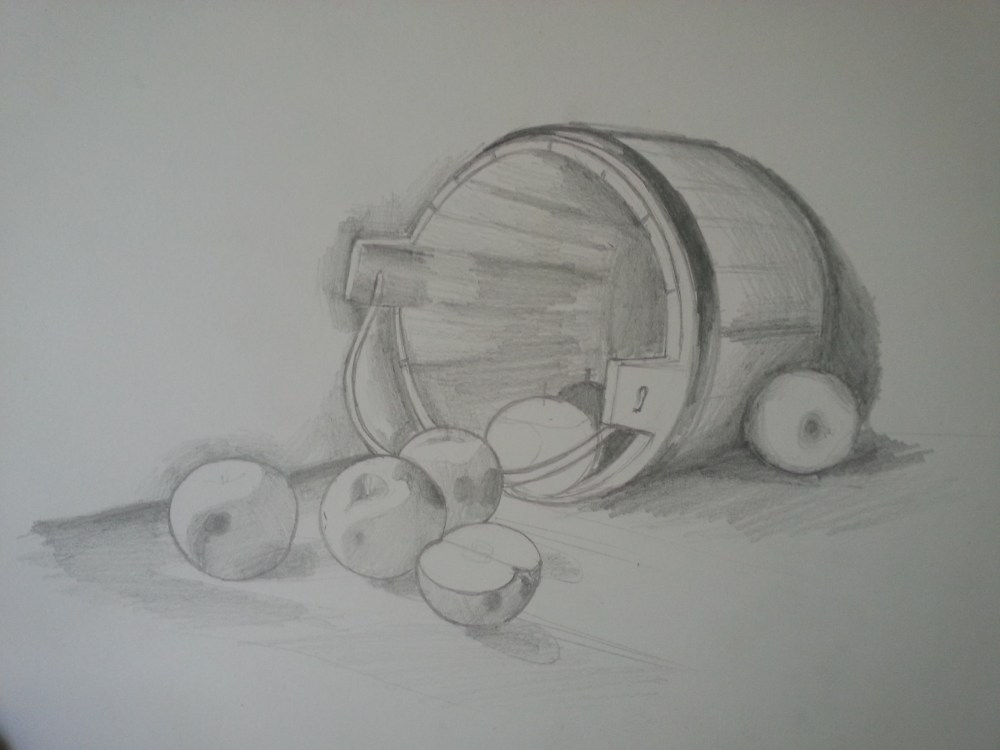
The focus of this stage is for the spaces around and between the objects. There are important points to consider in this stage. First the drawing of shade and light between the objects should be done carefully. Second, the shadows below and around the objects should also be shaded well to define the forms of the objects.
Step 7: Shading Technique Third Stage

Now is the stage to enhance the form of each object and making a great impact on the image. Your goal is to deepen the tone for each object by adding the contrast between the dark and light areas. However, you have to make sure that you keep the balance of the tones throughout your still life.
Step 8: Shading Technique Fourth Stage

Continue your focus on the spaces between the objects, increasing the level of contrast and deepen tones. Review that balance in the tonal values and the spaces between the objects to establish a unified image.
 AJ Gallery
Wow! Thank you so much. This is very interesting. 🙂
LikeLiked by 1 person